![[EN] Poladent](https://www.poladent.cz/en/wp-content/uploads/sites/2/2025/02/poladent-logo-primary-small.png)


A naturally beautiful smile — one you don’t have to think about when speaking, being photographed, or communicating in everyday situations — is today one of the most common reasons patients seek cosmetic dentistry.
In 2026, cosmetic dentistry offers a wide range of options, from professional teeth whitening to complex smile reconstructions using veneers or crowns. The goal, however, is not to create an artificial or uniform appearance, but a natural smile that respects the proportions of the face and the individuality of each patient.
Dissatisfaction with one’s smile has long been among the most frequent motivations for visiting a dental practice beyond routine check-ups.
What Is Cosmetic Dentistry
Cosmetic dentistry is the branch of dental medicine that connects function, health and aesthetics of the teeth. It is not merely about “cosmetic adjustments”, but about comprehensive smile planning with an emphasis on long-term stability, proper function and natural results.
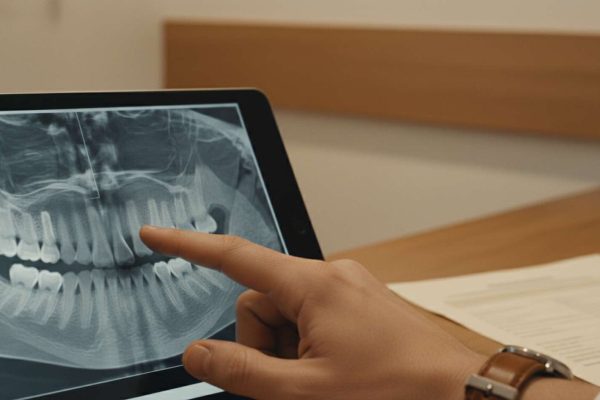
Modern cosmetic dentistry makes use of digital technologies such as Digital Smile Design (DSD). This allows the future appearance of the smile to be visualised before treatment begins, meaning the patient actively participates in planning the outcome.
At the same time, a strong emphasis is placed on minimally invasive procedures — the aim being to preserve as much of the patient’s own dental tissue as possible and to intervene only where absolutely necessary.
Overview of Aesthetic Treatments
Teeth Whitening
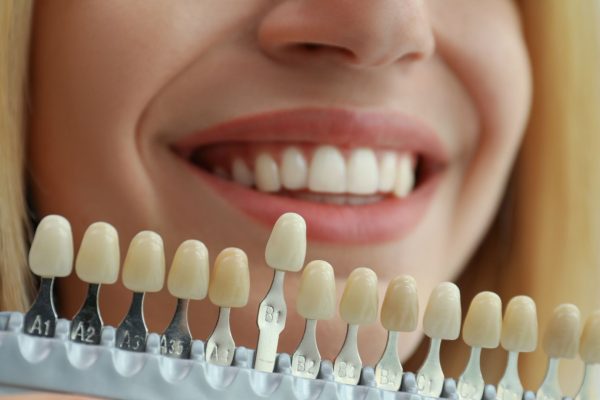
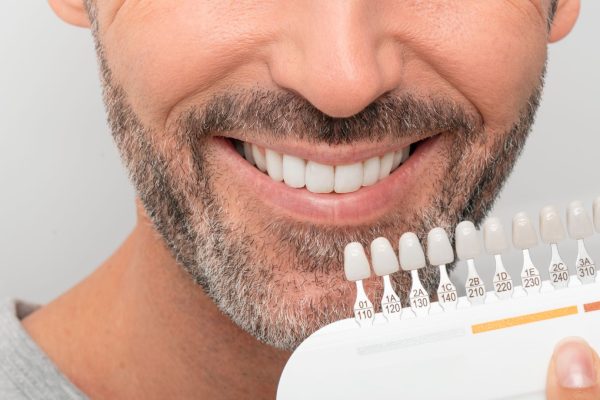
Teeth whitening is the most common introductory procedure in cosmetic dentistry. It is a non-invasive method that can effectively lighten the shade of teeth without altering their structure.
Either in-office whitening is used, which produces a rapid effect within a single appointment, or home whitening with custom-made trays, which works gradually over a period of days to weeks.
In practice, the two approaches are often combined — a quick in-office result followed by a home phase to stabilise the outcome.
Teeth whitening is particularly suitable for discolouration caused by coffee, tea, red wine or smoking.
Dental Veneers
Dental veneers are thin ceramic shells that are bonded to the front surface of the teeth. They allow the colour, shape and minor positioning of the teeth to be adjusted.
Modern materials, such as lithium disilicate ceramics, provide high strength as well as natural translucency.
In suitable cases, enamel preparation is minimal or even preparation-free.
Veneers are used primarily for:
- gaps between teeth
- permanent discolouration
- shape irregularities
- minor asymmetries
Dental Crowns
Dental crowns are used to reconstruct teeth that have been significantly damaged and can no longer be restored with a filling or veneer.
Modern all-ceramic and zirconia crowns make it possible to achieve a natural appearance without the metal margins that were typical of older prosthetic techniques.
They are indicated primarily for teeth following extensive loss or weakening of dental tissue.
Dental Bonding
Bonding is a quick and minimally invasive aesthetic procedure in which composite material is applied directly to the tooth and shaped to achieve the desired result.
It is used mainly for:
- minor shape corrections
- repairing chipped edges
- closing smaller gaps
The advantage is an immediate result within a single appointment. Longevity ranges from several years depending on care and loading.
Tooth Jewellery
Tooth jewellery is a non-invasive aesthetic enhancement of the smile. It consists of small decorative elements — such as crystals or gold motifs — bonded to the tooth surface using a special composite material.
The application is gentle, does not affect the dental tissue, and is fully reversible — the jewellery can be safely removed at any time without damaging the tooth. Tooth jewellery has no functional purpose and is used solely for aesthetic effect. It is suitable for patients with good dental health and excellent oral hygiene.
Careful hygiene around the jewellery is essential to prevent the build-up of plaque.
Hollywood Smile
A “Hollywood Smile” refers to a comprehensive aesthetic smile makeover. It is not a single procedure but a combination of several — typically whitening, veneers, crowns, bonding or gum adjustments.
The goal is not a uniform white smile, but a harmonious result that suits the proportions of the face and the individual features of the patient.
Frequently Asked Questions (FAQ)
Can multiple aesthetic procedures be combined?
Yes, combinations are common and often ideal. Treatment usually begins with whitening, as the resulting shade influences all subsequent aesthetic steps.
How do I recognise a quality aesthetic dentist?
A quality practice uses digital smile planning, provides photographic documentation, and offers a mockup — a temporary simulation of the result in the mouth.
How long does an aesthetic smile transformation take?
Whitening takes days to weeks, veneers several weeks, and complex reconstructions several months.
Is aesthetic dentistry suitable for sensitive teeth?
Yes, procedures can always be individually adapted, including the use of gentle materials and desensitising measures.
Conclusion
Aesthetic dentistry today offers a wide range of ways to improve both the appearance and function of the teeth. The key to success is not a quick fix, but careful diagnostics, systematic planning and respect for the natural structure of the teeth.
The path to a beautiful smile is therefore a process that brings together health, function and aesthetics into a single whole.