![[EN] Poladent](https://www.poladent.cz/en/wp-content/uploads/sites/2/2025/02/poladent-logo-primary-small.png)

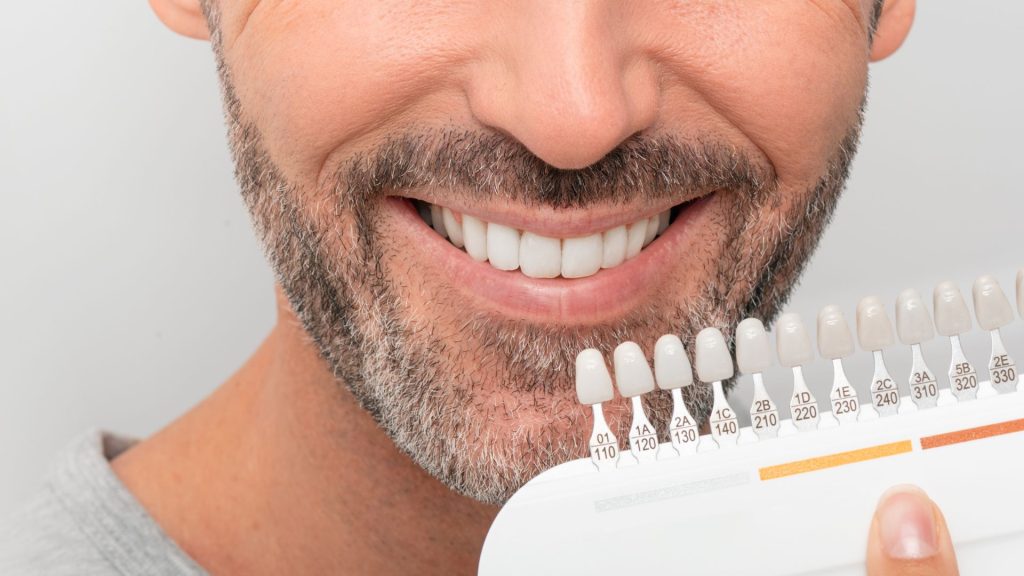
Teeth whitening is in 2026 one of the most sought-after aesthetic dental procedures. The reason is straightforward — it can visibly lighten the teeth in a relatively short time, improve the overall appearance of the smile, and remain gentle on the enamel when carried out professionally.
Everyday habits are largely behind tooth discolouration. Coffee, tea, red wine and smoking gradually cause pigments to build up in the enamel, leading to a loss of the teeth’s natural brightness. Professional whitening chemically breaks down these pigments and restores a lighter tooth shade.
How Teeth Whitening Works and What Affects Its Effectiveness
The principle of whitening is based on the action of active agents — most commonly hydrogen peroxide or carbamide peroxide. These break down in the mouth and the released oxygen penetrates the enamel, where it breaks apart colour pigments.
However, not all tooth stains originate in the same way. We distinguish between:
External discolouration (extrinsic) – caused by foods, drinks or smoking. Whitening responds very well to this type.
Internal discolouration (intrinsic) – caused, for example, by the use of antibiotics, excessive fluoride intake or dental trauma. The effectiveness of whitening here is more limited.
Whitening also does not affect the colour of fillings, crowns or veneers. If a comprehensive aesthetic treatment is planned, whitening should always precede any prosthetic work, so that the shades of natural and artificial teeth can be matched.
In-Office Teeth Whitening – Rapid Lightening by up to 8 Shades
In-office whitening takes place directly in the dental practice and is one of the fastest methods available. The dentist first carries out a professional dental cleaning, protects the gums with a special barrier, and then applies a whitening gel activated by an LED lamp or laser.
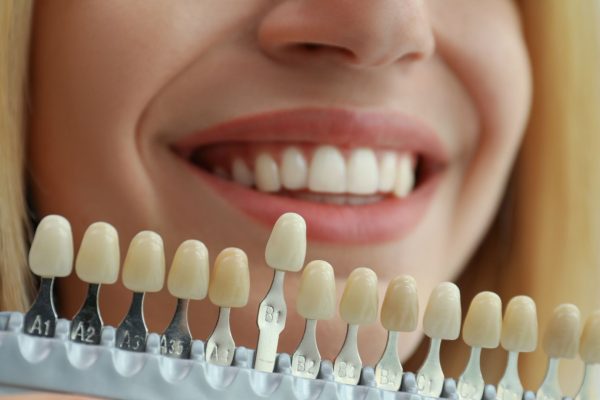
The entire process takes approximately 60–90 minutes and can result in lightening by as much as 6–8 shades. The advantages are the rapid effect, precise control of the entire process and the ability to respond immediately to any tooth sensitivity.
Combined Teeth Whitening – The Most Effective Method for Long-Lasting Results
Combined whitening brings together the in-office procedure with a home phase. An initial treatment is performed in the dental practice, and at the same time a custom-made tray is fabricated.
The patient then continues with home whitening, further deepening and stabilising the effect. The result is a very pronounced yet natural-looking lightening of the teeth. This method is one of the most effective whitening options available.
Home Teeth Whitening Under Dental Supervision
Home whitening is carried out with a custom-made tray into which the patient applies the whitening gel. The gel typically contains 10–16% carbamide peroxide and is used for 30–60 minutes a day for approximately 10–14 days.
The result is a gradual lightening of 3–6 shades that looks very natural. The advantages include the convenience of home application and the option to use the tray for future maintenance whitening.
Over-the-Counter Whitening Products
Whitening strips, gels and LED kits are widely available in shops. However, their effect is limited, as EU regulations allow only very low concentrations of peroxide.
The result is typically lightening by just 1–2 shades, which also tends not to be long-lasting. Products from overseas online retailers additionally carry the risk of containing concentrations of active agents that exceed EU-permitted limits.
Who Is Suitable for Teeth Whitening and When Is It Not Recommended
Whitening is suitable for adult patients with healthy teeth and gums, particularly where discolouration is caused by external factors — coffee, tea, wine or smoking.
However, it is not suitable in the following cases:
- untreated tooth decay or gum disease
- pregnancy and breastfeeding
- allergy to hydrogen peroxide
- extensive fillings or crowns in the aesthetic zone
- patients under 18 years of age
How Long Do Whitening Results Last and What Affects the Outcome
Whitening results typically last between 6 months and 2 years. The duration depends primarily on lifestyle — in particular, consumption of coffee, tea, red wine and smoking.
The most critical period is the first 48 hours after the procedure, when the teeth are more susceptible to renewed discolouration. During this period, a so-called “white diet” is recommended — avoiding pigmented foods and drinks.
How to Maintain Whitening Results for as Long as Possible
For long-lasting results, it is advisable to follow several guidelines:
- regular dental hygiene appointments at least twice a year
- reducing smoking and consumption of staining drinks
- drinking coffee and tea through a straw
- maintenance whitening approximately once every 12–18 months
Frequently Asked Questions About Teeth Whitening (FAQ)
Can whitening damage the teeth?
Not when performed correctly and under professional supervision.
How often should whitening be repeated?
Typically once every 1–2 years, depending on lifestyle.
Does whitening work on crowns and veneers?
No — they do not change colour.
Who should avoid whitening?
Pregnant and breastfeeding women, children under 18, patients with untreated decay, gum disease or an allergy to hydrogen peroxide.