![[EN] Poladent](https://www.poladent.cz/en/wp-content/uploads/sites/2/2025/02/poladent-logo-primary-small.png)

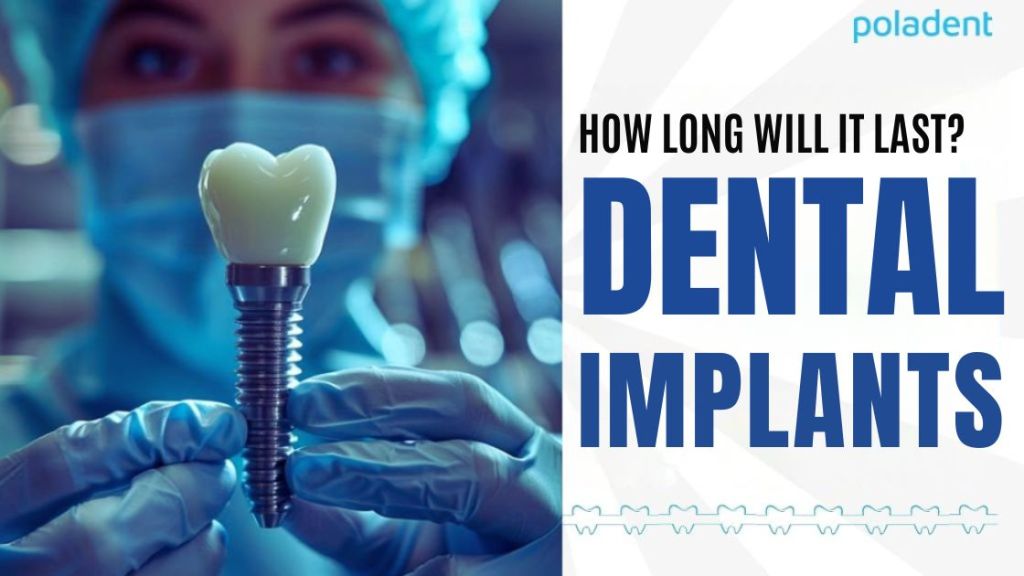
Dental implants are considered the most modern and reliable method of replacing teeth today. They offer stability, aesthetics, and the feel of natural teeth. However, one of the most frequent questions patients ask in practice is: How long does an implant last? And what can I do to extend its lifespan?
In this article, we explain in detail how long dental implants last on average, which factors influence this lifespan, and how to care for the implant so that it serves you well for many years – ideally for your entire life.
What is a dental implant?
Before we discuss lifespan, let’s briefly explain what a dental implant actually is. It’s a titanium (or zirconium) screw that is surgically inserted into the jawbone and replaces the root of a missing tooth. A crown, bridge, or full denture (e.g., All-on-4) is then attached to it.
The implant will become a part of your body and is designed for a very long lifespan.
Average lifespan of the implant
Statistics and long-term studies show that dental implants have a success rate of over 95% in the first 10 years . With proper care, however, they can easily last 20–30 years or longer .
It’s important to know that the implant itself (the screw in the bone) usually has a longer lifespan than the crown or prosthesis attached to it. These components may need to be replaced over time due to normal wear and tear.
What influences the durability of an implant?
1. Oral hygiene:
Just like with your own teeth, cleanliness is essential. Regularly cleaning your teeth and the spaces between them (ideally with a water flosser) reduces the risk of inflammation that could endanger the surrounding tissue and the implant itself.
2. Smoking:
Smoking significantly impairs healing and increases the risk of implant failure. Long-term smokers can still suffer bone and implant loss even after several years.
3. Regular check-ups
are essential. Visits to the dentist and dental hygienist are crucial. A professional can detect even minor problems before they develop into more serious complications.
4. Bone quality and general health:
Strong, healthy bone is crucial for the stability of the implant. Conditions such as osteoporosis, diabetes, or autoimmune diseases can impair the implant’s durability – but even in these cases, implantation can be successful with the right approach.
5. Overloading of implants:
Teeth grinding (bruxism), chewing on hard objects (e.g., pens), or uneven load distribution can damage the implant. Therefore, patients with this problem are sometimes recommended to wear a bite splint.
What does the care of dental implants look like?
Many people believe that implants don’t need any care – quite the opposite. While the care of an implant isn’t fundamentally different from the care of your own teeth, it is all the more important.
- Brush your teeth twice a day , ideally with an electric toothbrush.
- Use interdental brushes or dental floss.
- Consider using a mouthwash.
- Have your teeth professionally cleaned at least twice a year.
- Do not ignore any signs of inflammation (bleeding, swelling, pain).
The implant will not last “for life” without your help.
Although the implant is made of extremely durable materials and dentists nowadays use state-of-the-art technologies, the ultimate durability is primarily influenced by your approach to the treatment .
Thanks to modern implantology, it is now possible to give even older patients functional and aesthetically pleasing teeth with long-lasting results. Many patients report that after just a few months they no longer notice they have an artificial tooth – everything feels and looks natural.
Are you considering dental implants?
If you are considering dental implants and are wondering whether they are suitable for you and how long they will last in your specific case, we recommend that you consult a specialist.
👉 Schedule a consultation with Dr. Polach at our Poladent practice in Pilsen. He has many years of experience with implants and will individually assess which procedure is best suited for you. Thanks to his professional approach and state-of-the-art technologies, you can be sure that your new teeth will be stable, functional, and long-lasting.